
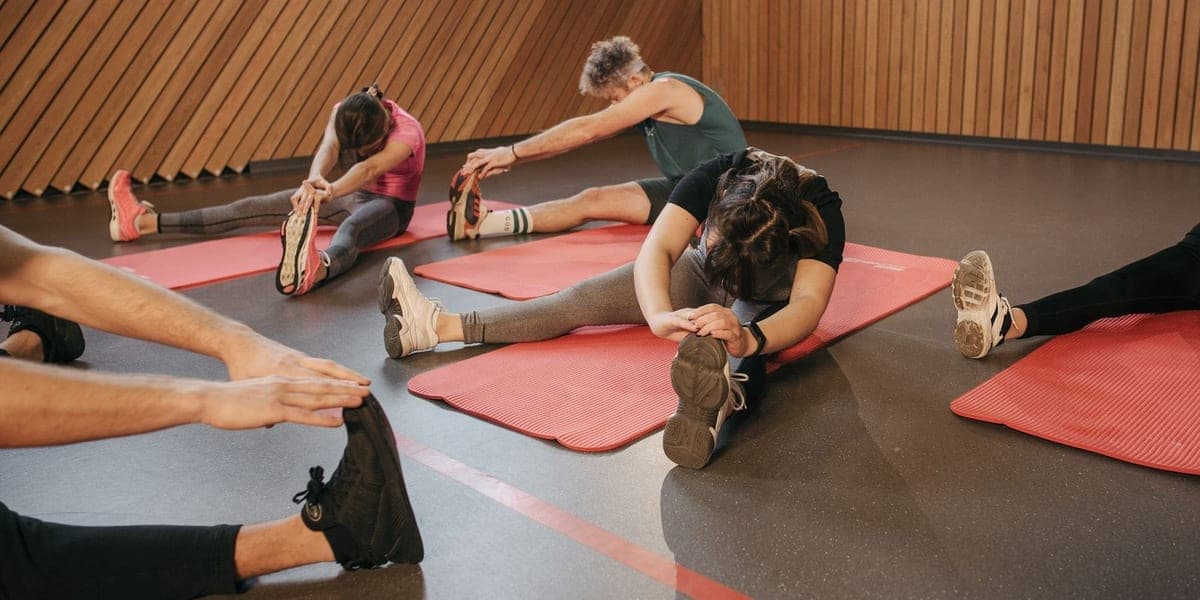
You do not need to touch your toes to have a useful conversation about stretching. Flexibility photos tend to show the final position, while leaving out the person's history, training and reasons for being there. Your own starting point may be much less dramatic: understanding a stretch in a class or deciding where flexibility work fits in your week.
Begin with a practical question about movement rather than a pose you want to copy. What activity are you preparing for, and what feels difficult? The answer can help you decide whether general stretching information is enough or whether an instructor, physical therapist or clinician should guide you.
Know what the evidence does and does not say
Mayo Clinic's 2023 flexibility guide, reviewed for this article in September 2026, explains that stretching can improve flexibility and joint range of motion. It also describes mixed findings for other outcomes: stretching does not reliably prevent post-exercise soreness, and prolonged holds immediately before explosive activity may affect performance.
That makes flexibility a reasonable focus, without promising that a few stretches will prevent every injury or solve every ache. Think about the outcome you want to discuss. “I would like to understand how to move comfortably in this class” is a clearer starting point than “I should be more flexible.”
A photograph cannot tell you whether a position is appropriate for your body. Use demonstrations to understand an explanation, then seek help adapting it when needed. The aim is to learn, not to reproduce someone else's range.
Separate stretching from warming up
Mayo Clinic advises warming up with light activity before stretching and using smooth movements without bouncing. It recommends tension rather than pain, normal breathing and attention to both sides of the body. Stretching is not itself a complete warmup.
If you attend a class, ask the instructor which part is the warmup and which part is flexibility work. A session may contain several kinds of movement, and knowing the purpose makes the instructions less confusing. You should not have to infer it from everyone else.
For a sport or more demanding workout, ask about preparation that fits that activity. The same sequence need not serve a quiet flexibility session and a sprint session. This guide is a framework for planning questions, not a prescribed sequence or a rehabilitation program.
Choose a setting where you can pay attention
Before following an exercise demonstration, look at the space you intend to use. Do you have enough room? Can you see or hear the instructions without twisting to watch a screen? Is getting down to and up from the floor comfortable for you?
If a floor-based session does not suit, ask about another format. Tell an instructor about access needs before the class begins, when there is time to discuss them. You can ask for seated or standing options without having to explain your entire medical history to a room of strangers.
Avoid adding equipment simply because it appears in a video. Find out what it is for and whether it is appropriate for you. A strap, block or chair is useful only if you know how the instructor intends it to be used.
Get clear on the instruction
A good explanation should tell you where to position yourself, how to move into the stretch and how to come out again. If any of those stages is unclear, pause and ask. Guessing becomes especially awkward when a video has already moved on.
You can say, “I feel this somewhere different from where you described,” or “I cannot hold that position comfortably.” Those are useful observations. They give an instructor information for adjusting the explanation instead of leaving you to push further because others seem comfortable.
Choose a small number of movements to learn properly before collecting more routines. Save the name of the class or exercise so you can ask a specific follow-up question. A growing list of unfamiliar stretches is not necessarily a better plan.
Leave comparison out of the session
Some people enter a class with years of dance or sports experience; others are learning the movements for the first time. A group setting can hide those differences. Keep your attention on understanding the instruction and responding to your own experience.
You do not need to photograph your reach or measure progress against a person on the next mat. If recording something helps, note whether the instructions made sense and whether you need an alternative. Those details are useful at the next session.
Try changing the language of your goal. Instead of “I must reach the floor,” consider “I want a routine I understand and can discuss with my instructor.” The second goal gives you a practical next step without attaching success to a single body position.
Know when general advice is not enough
If you have an injury, persistent pain, a recent operation or a condition affecting movement, speak with your clinician or physical therapist before starting a new stretching protocol. Pregnancy and other individual circumstances can also change which guidance is appropriate.
Describe the activity you want to do and what happens when you try it. Ask whether stretching is relevant, what to avoid and whether you need an assessment. Stretching should not become a way of repeatedly testing a painful area while postponing that conversation.
Stop a movement that hurts rather than treating pain as evidence of progress. If symptoms persist or recur, bring them to a healthcare professional. A general article cannot determine their cause.
Make the next session easier to organize
Once you have suitable guidance, decide where it belongs in your schedule. Keep the instructions accessible, allow time to ask questions and choose a setting that you can use consistently. If a planned session does not happen, reconsider the arrangement instead of adding extra work as a penalty.
At your next check-in with an instructor, mention what was clear, what was uncomfortable and what you could realistically repeat. That feedback can help make the routine more appropriate. A useful stretching practice begins with understanding what you are doing and why, not with reaching the most impressive position.
Photo: Pavel Danilyuk on Pexels. Image illustrates a group session, not an individualized exercise prescription.