
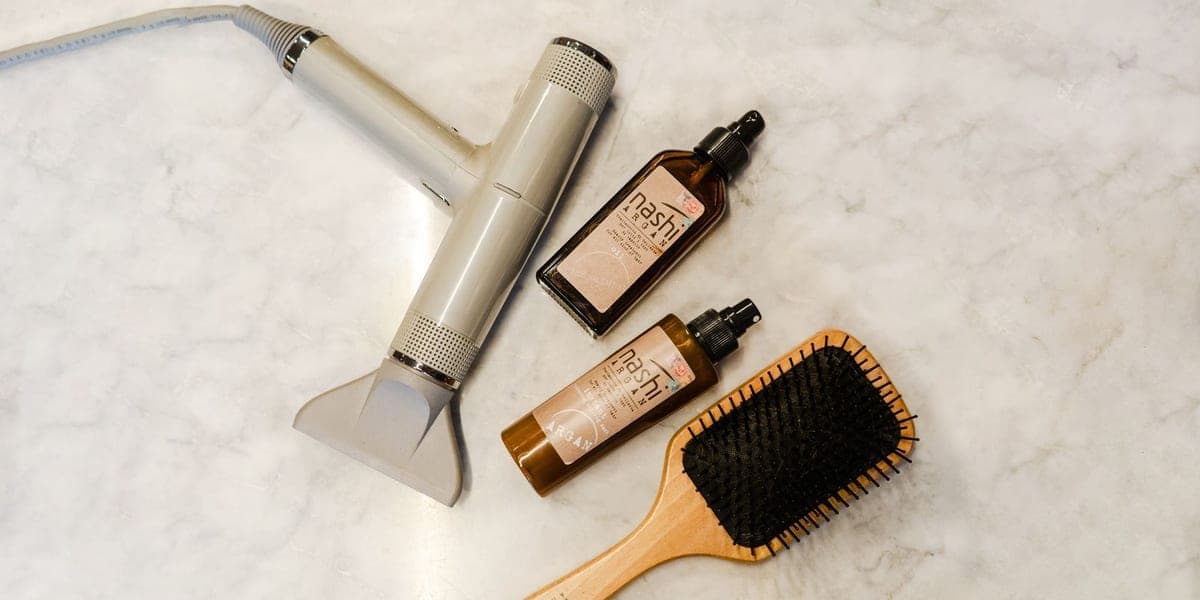
The dryer comes out after washing, the straightener follows, and the next morning another quick pass seems necessary. Heat styling can become a sequence you barely notice until your hair feels harder to manage.
A gentler routine starts with understanding that sequence. You do not have to give up a style you enjoy or buy an entirely new set of products. It helps to know when heat is doing a job you value, when it has become automatic, and whether a change in your hair needs more than a styling adjustment.
Look at frequency before shopping
The American Academy of Dermatology's advice on styling without damage, checked in September 2026, says excessive heat can damage hair regardless of hair type. It recommends reducing how often you blow-dry, allowing partial air-drying where appropriate, and using flat irons on dry hair at low or medium settings.
Begin by noticing your own pattern over a normal week. Include brief touch-ups, not just the day you wash and fully style your hair. You might discover that the part taking the most heat is a small front section you repeatedly redo.
Write down what each session is meant to achieve. Are you drying wet hair, changing its shape, or smoothing a detail that only you notice? This is not a test of whether you should care about your appearance. It helps you identify which steps are worth keeping and which you could skip without missing the result.
A new tool cannot answer those questions for you. Start with the routine you already have, then decide whether equipment is actually the problem.
Make drying and detangling fit your hair
One universal instruction does not suit every texture. The AAD's healthy-hair tips, updated in 2024, distinguish between handling straight hair and thick, curly hair.
Its guidance includes using a wide-tooth comb gently, beginning at the ends and working upward. For thick curls, combing while conditioner is still in the hair can be useful; straight hair can be allowed to dry a little before combing. Wrapping hair in a towel or T-shirt absorbs moisture more gently than vigorous rubbing.
Consider what that means for your setup. If the comb is stored across the room and you always reach for the nearest brush, put the appropriate tool where you need it. If you rush because the dryer is your only plan for finishing on time, allow a different washing window when practical.
Ask a stylist experienced with your texture to demonstrate a manageable method. “Show me how to do this with the time and tools I have at home” is a useful request. A salon result that depends on techniques you cannot repeat may not be the right model for an everyday routine.
Use the controls deliberately
Before turning a tool on, check its instructions and identify its heat settings. The highest setting should not become the default simply because it is the first one you used.
AAD guidance favors low or medium heat and a heat-protective product. Follow both the tool's instructions and the product's directions. Using a protective product does not cancel the advice to limit heat exposure.
Give yourself a stopping point. For example, decide which sections actually need attention before beginning. Otherwise it is easy to keep inspecting, reheating and correcting without a clear idea of when the style is finished.
If your routine depends on repeated passes that still do not produce the result you want, discuss the method with a qualified stylist. Bring the tool name and the product names so the conversation can be specific. There may be a different styling approach that better matches your hair and expectations.
Keep electrical tools away from water and follow their storage and cooling instructions. A styling session is easier to finish safely when there is already an appropriate place to set the tool down.
Plan a style for days without hot tools
Choosing fewer heat-styling sessions is easier when the alternative is concrete. You might prefer a looser version of your usual style, a different parting or an accessory that feels comfortable.
Try the alternative on a day with some flexibility. That gives you time to decide whether it feels like you, rather than judging it in the last minute before leaving home. A photograph can help you remember a version you liked without trying to reconstruct it later.
Avoid replacing heat with constant pulling. The AAD's styling guidance warns that tightly worn styles can create tension, breakage and, over time, hair loss. Comfort matters when choosing how to keep hair out of your face.
You do not need to make a public declaration about changing your routine. It can be as ordinary as choosing not to straighten one morning, then noticing whether that was a change you would like to repeat.
Do not assume every change is heat damage
Short broken strands, increased shedding and visible thinning are observations, not interchangeable diagnoses. Scalp discomfort is another reason to look beyond the styling tool.
The AAD's guidance for people concerned about hair loss, checked in September 2026, recommends seeing a dermatologist to understand the cause. It also cautions against taking hair-growth supplements without knowing whether you need them.
If you arrange an appointment, bring a brief timeline: when you noticed the change, any new products or chemical services, and your usual styling practices. Mention medical changes and medicines as well. Do not stop prescribed treatment on your own.
Check with a clinician before starting supplements, particularly during pregnancy, when taking medication or with an existing health condition. A product marketed for stronger hair is not a substitute for an assessment.
Choose one adjustment you can keep
A practical first change might be fewer touch-ups, gentler detangling or a clearer low-heat setting. Pick the step that addresses something you actually noticed in your routine.
Then assess whether it is workable. Does it fit the time available? Can you manage the tools comfortably? Are symptoms persisting despite the adjustment? Those answers matter more than reproducing someone else's routine exactly.
The aim is hair care you can carry out with less unnecessary handling and clearer expectations. When there is a persistent concern, getting an explanation is part of that care.
Photo: Rosa Isela Sias Talamantes on Pexels. Illustrative photograph; pictured products are not recommendations.